
California Mechanics Lien Notices and Waivers: A Practical Project Checklist
Understand preliminary notices, lien releases, waivers, payment tracking and owner-contractor communication on California construction projects.
Mechanics liens and payment waivers can turn an ordinary invoice disagreement into a dispute that affects property title, cash flow, and working relationships. Owners want assurance that bills are being paid; contractors and suppliers want to protect legitimate payment rights. The terms of a waiver or the timing of a notice may matter as much as the dollar amount involved. This guide explains a practical recordkeeping framework for California construction projects without pretending that one checklist substitutes for a review of the project and applicable statutes.
Key idea: A careful factual record protects decision-making even when the parties disagree about legal responsibility. Use the steps below as a working framework, not a substitute for project-specific advice.
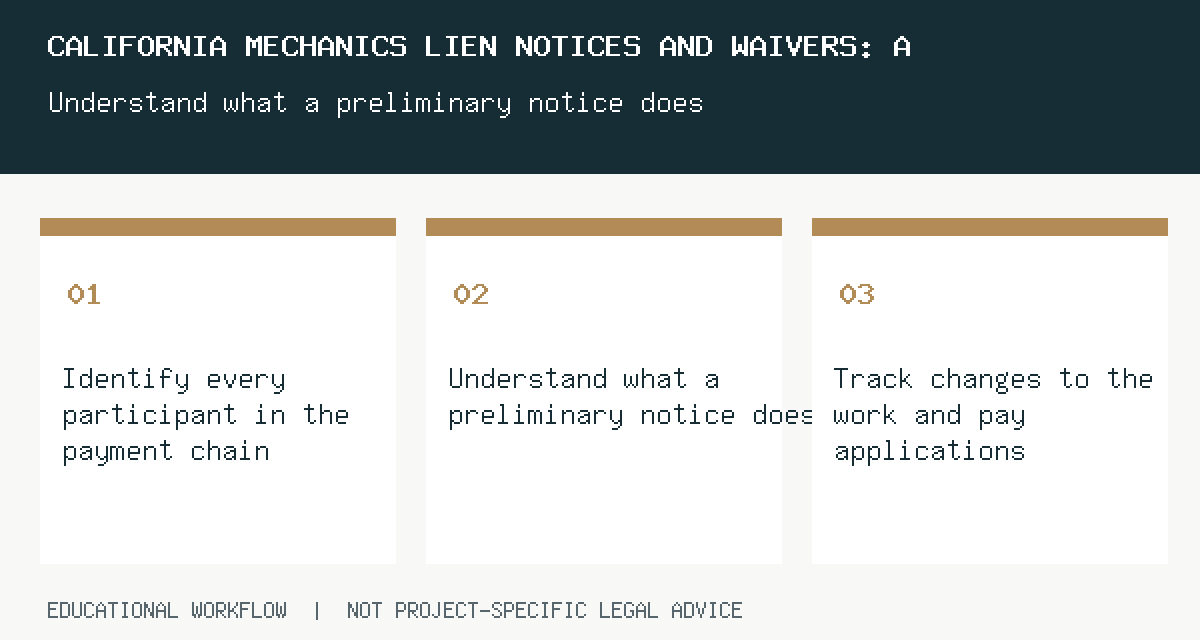
Identify every participant in the payment chain
An owner often sees only the prime contractor’s invoice, while suppliers, laborers, and subcontractors may have separate payment concerns. The question is not simply whether someone believes identify every participant in the payment chain matters; it is which documents support the conclusion and which facts are still disputed. An effective project record is designed for somebody who was not present when the events occurred. Dates, document authors, the version of a drawing, and the reason an action was taken should all remain visible. When the parties later discuss a claim, that context makes it easier to distinguish a contemporaneous fact from a retrospective interpretation.
Build a project contact register listing legal names, trade, role, contract tier, start dates, and the party that receives each invoice. The strongest explanation separates the observed event from later assumptions. That distinction makes discussions about money, schedule and responsibility easier to follow. An efficient review begins with the question being answered, not the size of the document collection. Group the material by topic and cross-reference it to a chronology. If a key record is missing, identify the gap openly instead of allowing an assumption to stand in for evidence. This helps preserve credibility.
A delivery ticket from a material supplier can identify another participant whose name never appeared on the general contractor’s original proposal. Project teams are often under pressure to reach an immediate operational answer. The decision to keep work moving can coexist with a written record that a price, deadline, or contractual issue remains unresolved. Clear written reservations are more useful than vague language implying the parties already reached agreement.
Do not assume that paying the prime contractor automatically resolves every downstream lien risk. Not every disagreement warrants a formal claim. Many can be narrowed through a targeted request for documents, a meeting of responsible decision-makers, or an agreed technical review. The choice depends on the agreement, the potential financial impact, available evidence, and the risk of letting an applicable deadline pass.
Understand what a preliminary notice does
A preliminary notice identifies a potential lien claimant and puts recipients on notice that particular labor or materials may support a claim. Read this issue alongside the signed contract and the actual sequence of work. A sensible next step may differ for a property owner, a direct contractor, and a subcontractor. Not every disagreement warrants a formal claim.
Record each notice’s date, delivery method, sender, stated amount if any, and the work or supplies described; save the complete envelope or electronic proof. A useful working file makes the answer auditable: the reader can see the original record, the date, the person involved, and what changed afterward. Consider the perspective of each project participant. The owner may focus on financing, safety and completion; a contractor may focus on sequence, cash flow and contract administration; a subcontractor may focus on access and timely payment. Their objectives differ, but an accurate shared factual record can improve the conversation.
For example, if a supplier delivers lumber over several dates, compare the notice information against the delivery log and purchase records. The most useful documents often predate the dispute: approved plans, dated notes, routine status reports and formal notices. Preserve originals, maintain reliable backups and avoid rewriting the past to fit a later narrative. A transparent correction note is preferable to quietly changing the underlying record.
Notice rules differ among claimant types; California CSLB notes that direct contractors and laborers are treated differently from many subcontractors and suppliers. Financial summaries should reconcile with the source material. An amount marked requested, approved, invoiced, paid or withheld has a different meaning. Where the parties disagree, label the disagreement. Never present an estimate as a paid cost or a proposed change as an executed amendment.
Track changes to the work and pay applications
The amount originally agreed may differ from the final amount because approved additions, deletions, or disputed work changed the scope. Financial summaries should reconcile with the source material. Where the parties disagree, label the disagreement.
Place the baseline contract, each change order, progress billing, payment certificate, retention record and payment receipt in one chronological ledger. The question is not simply whether someone believes track changes to the work and pay applications matters; it is which documents support the conclusion and which facts are still disputed. Before sending a strongly worded response, identify which statements can be supported and what questions remain open. An accurate, restrained letter can reserve an issue without escalating every factual uncertainty into an accusation. Appropriate communication strategy depends on both the commercial relationship and the legal setting.
A pending change order may be carried in an invoice even though the parties disagree whether anyone authorized it. Build a decision calendar with dates for follow-up, missing documents, meetings and any potentially applicable notices. Because construction deadlines can be highly specific and event-driven, have qualified counsel review the contract and relevant law rather than relying solely on a generic administrative calendar.
Do not treat a draft change order or a line on a spreadsheet as conclusive evidence of contractual approval.
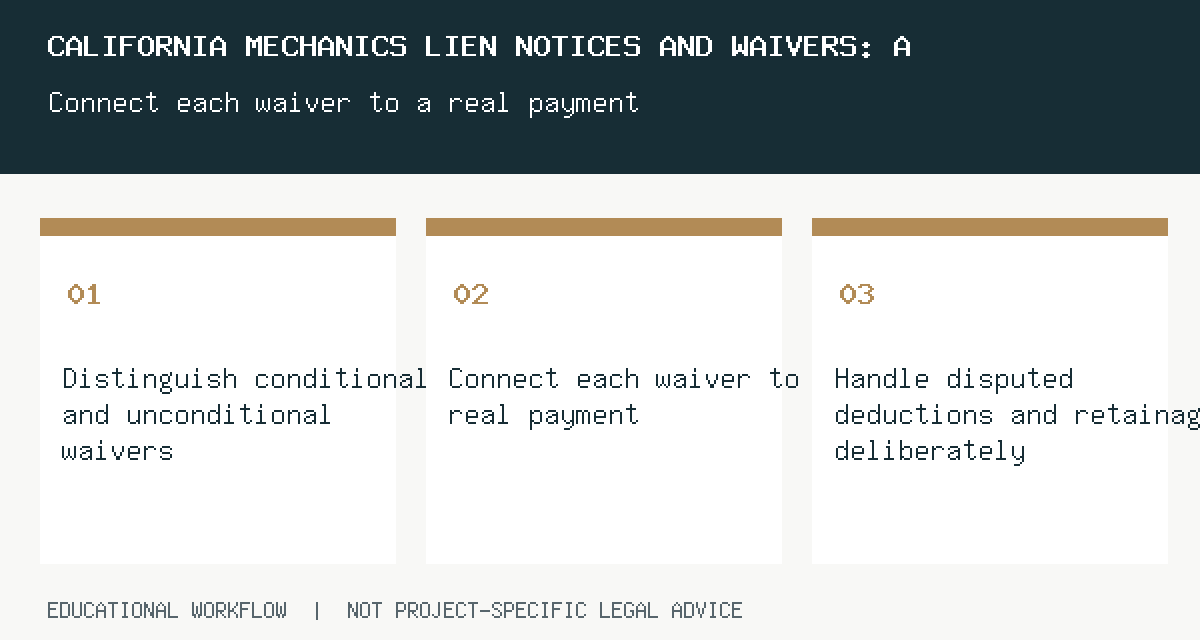
Distinguish conditional and unconditional waivers
Waiver forms can carry materially different consequences depending on what payment has actually been made and the period the waiver covers.
Before signing, compare the form type, through-date, dollar amount, exceptions and whether the relevant payment has cleared. This helps preserve credibility.
A subcontractor asked for an unconditional progress waiver before receipt of funds should recognize that the document may communicate more than a promise to sign later.
Never use a waiver form mechanically; California provides statutory waiver language and the proper form depends on the circumstances. Not every disagreement warrants a formal claim.
Connect each waiver to a real payment
A waiver is much easier to review when the accompanying invoice, approved amount and payment evidence are visible together. The question is not simply whether someone believes connect each waiver to a real payment matters; it is which documents support the conclusion and which facts are still disputed. Not every disagreement warrants a formal claim.
Assign one tracking number to the pay application, waiver, remittance advice, joint check if used, and proof of deposit. Consider the perspective of each project participant.
An owner reviewing three suppliers’ waivers can compare their coverage periods to the general contractor’s requested draw.
Avoid filing unsigned PDFs under a generic final-waiver label without checking what was actually signed and by whom. Financial summaries should reconcile with the source material. Where the parties disagree, label the disagreement.
Handle disputed deductions and retainage deliberately
Retainage, backcharges, punch-list costs and allegations of defective work can make the net amount owed difficult to agree upon. Financial summaries should reconcile with the source material. Where the parties disagree, label the disagreement.
Separate undisputed work from proposed deductions, identify the contractual basis for each item and request supporting details.
A contractor may acknowledge a correction item but disagree with a deduction that also includes unrelated delay charges.
Do not automatically net every contested amount against another invoice without reviewing payment and dispute terms.
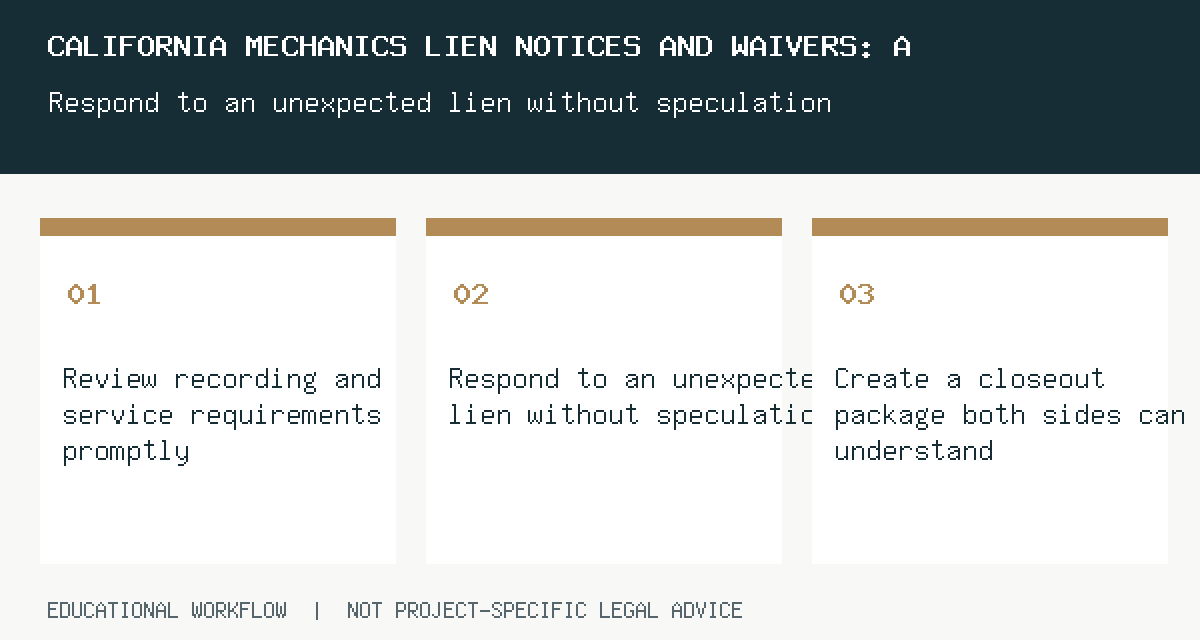
Review recording and service requirements promptly
Lien rights and remedies can depend on short, event-driven legal deadlines, including completion and the timing of notices.
Create a dates table for last work, substantial completion, recording, mailing, service and any notice of completion or cessation. The question is not simply whether someone believes review recording and service requirements promptly matters; it is which documents support the conclusion and which facts are still disputed. This helps preserve credibility.
A project may appear ongoing to one trade even after an owner takes possession or files a formal completion document.
Internet summaries of deadlines may omit exceptions. Have counsel calculate deadlines from the actual facts, contract, and current law. Not every disagreement warrants a formal claim.
Respond to an unexpected lien without speculation
A recorded lien can affect a sale or refinancing even when the owner disputes the claim. Not every disagreement warrants a formal claim.
Preserve the recorded document and proof of service, identify the claimant, request the underlying contract and invoices, and assemble the payment trail. Consider the perspective of each project participant.
An owner who has already paid the prime contractor may still need to examine who received downstream payments and which notices were served.
Do not assume that a disputed lien is automatically invalid or that ignoring it will cause it to disappear. Financial summaries should reconcile with the source material. Where the parties disagree, label the disagreement.
Create a closeout package both sides can understand
Good closeout records may reduce confusion over final payment, remaining work, warranty information, and lien documentation. The question is not simply whether someone believes create a closeout package both sides can understand matters; it is which documents support the conclusion and which facts are still disputed. Financial summaries should reconcile with the source material. Where the parties disagree, label the disagreement.
Maintain a final invoice ledger, completion and inspection evidence, punch-list status, relevant waivers and releases, and correspondence about remaining items.
If the project changes hands internally, a new manager should be able to reconstruct what was paid and why in less than an hour.
Keep executed copies and avoid overwriting prior versions; a clean chronology is more valuable than a polished but incomplete summary.
Project record checklist
- Identify every participant in the payment chain: Build a project contact register listing legal names, trade, role, contract tier, start dates, and the party that receives each invoice.
- Understand what a preliminary notice does: Record each notice’s date, delivery method, sender, stated amount if any, and the work or supplies described; save the complete envelope or electronic proof.
- Track changes to the work and pay applications: Place the baseline contract, each change order, progress billing, payment certificate, retention record and payment receipt in one chronological ledger.
- Distinguish conditional and unconditional waivers: Before signing, compare the form type, through-date, dollar amount, exceptions and whether the relevant payment has cleared.
- Connect each waiver to a real payment: Assign one tracking number to the pay application, waiver, remittance advice, joint check if used, and proof of deposit.
- Handle disputed deductions and retainage deliberately: Separate undisputed work from proposed deductions, identify the contractual basis for each item and request supporting details.
- Review recording and service requirements promptly: Create a dates table for last work, substantial completion, recording, mailing, service and any notice of completion or cessation.
- Respond to an unexpected lien without speculation: Preserve the recorded document and proof of service, identify the claimant, request the underlying contract and invoices, and assemble the payment trail.
- Create a closeout package both sides can understand: Maintain a final invoice ledger, completion and inspection evidence, punch-list status, relevant waivers and releases, and correspondence about remaining items.
Questions people often ask
Does a preliminary notice mean a lien has already been filed?
No. A preliminary notice is generally a different document from a recorded mechanics lien. It is an important signal to keep records and evaluate potential exposure. The applicable agreement, contemporaneous records and particular project facts should be reviewed before making an irreversible decision.
Can the owner request proof that suppliers are paid?
Owners can ask for records, waivers, or other confirmation appropriate to the contract. Joint checks may be relevant in some circumstances.
Does every claimant have the same deadline?
No. Claimant status, event dates and other circumstances can change the analysis. Prompt, project-specific legal review is essential.
Should an unconditional waiver be signed before receiving money?
Do not assume it is harmless. The consequences depend on the form and facts; review the applicable statutory language and obtain advice.
Related construction law guidance
- Mechanics liens and payment rights
- Construction contracts and disputes
- Project claims and resolution
- Discuss the issue with construction counsel
For an independent reference, review California CSLB mechanics lien guidance.
Legal information only, not legal advice. Requirements, defenses, and deadlines depend on the contract, project, jurisdiction and facts. Viewing this page does not create an attorney-client relationship. Consult qualified counsel about your circumstances.
Discuss your construction law matter
Construction disputes are fact-specific. Share the project background and learn how a focused legal review can help clarify your next decision.