
Construction Delay Claims: Records That Help Explain What Really Happened
Learn which schedules, daily reports, notices, correspondence and impact records help explain construction delay and disruption disputes.
A construction project can finish late for several reasons at once: access restrictions, delayed design responses, severe weather, missing material, rework or the sequence of other trades. The completion date alone rarely explains who caused what. A credible delay discussion starts with the contract schedule, contemporaneous records and a careful comparison of planned and actual work. This educational guide focuses on organizing those facts so owners, contractors and advisors can assess the issues before positions harden.
Key idea: A careful factual record protects decision-making even when the parties disagree about legal responsibility. Use the steps below as a working framework, not a substitute for project-specific advice.
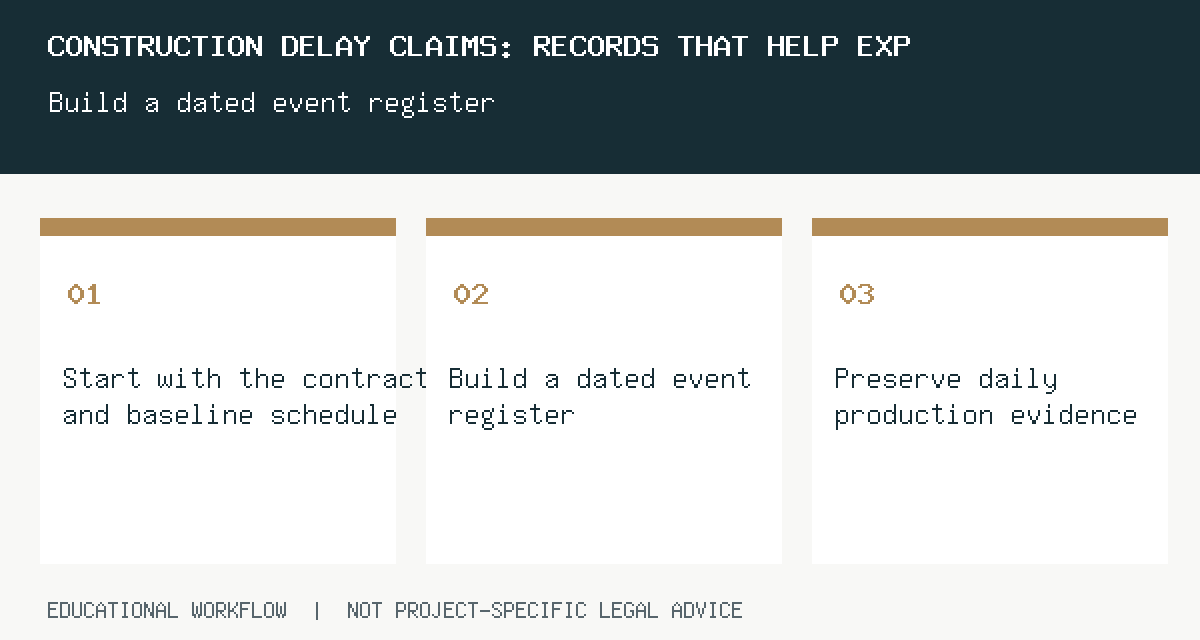
Start with the contract and baseline schedule
Time obligations may come from milestone dates, notice provisions, progress schedules, access assumptions and sequencing requirements. The question is not simply whether someone believes start with the contract and baseline schedule matters; it is which documents support the conclusion and which facts are still disputed. An effective project record is designed for somebody who was not present when the events occurred. Dates, document authors, the version of a drawing, and the reason an action was taken should all remain visible. When the parties later discuss a claim, that context makes it easier to distinguish a contemporaneous fact from a retrospective interpretation.
Retain the approved baseline schedule, contract calendar, milestone definitions, float conventions and schedule-submission correspondence. The strongest explanation separates the observed event from later assumptions. That distinction makes discussions about money, schedule and responsibility easier to follow. An efficient review begins with the question being answered, not the size of the document collection. Group the material by topic and cross-reference it to a chronology. If a key record is missing, identify the gap openly instead of allowing an assumption to stand in for evidence. This helps preserve credibility.
A contract might identify substantial completion separately from final punch-list closeout, making the relevant deadline more nuanced. Project teams are often under pressure to reach an immediate operational answer. The decision to keep work moving can coexist with a written record that a price, deadline, or contractual issue remains unresolved. Clear written reservations are more useful than vague language implying the parties already reached agreement.
Avoid relying on an exported image of a bar chart when native scheduling files and revision history are available. Not every disagreement warrants a formal claim. Many can be narrowed through a targeted request for documents, a meeting of responsible decision-makers, or an agreed technical review. The choice depends on the agreement, the potential financial impact, available evidence, and the risk of letting an applicable deadline pass.
Build a dated event register
Delay allegations become clearer when the actual starting point, responsible activity and duration are recorded. Read this issue alongside the signed contract and the actual sequence of work. A sensible next step may differ for a property owner, a direct contractor, and a subcontractor. Not every disagreement warrants a formal claim.
List each event by start date, end date, affected location, workstream, notice, source document and stated impact. A useful working file makes the answer auditable: the reader can see the original record, the date, the person involved, and what changed afterward. Consider the perspective of each project participant. The owner may focus on financing, safety and completion; a contractor may focus on sequence, cash flow and contract administration; a subcontractor may focus on access and timely payment. Their objectives differ, but an accurate shared factual record can improve the conversation.
A delayed drawing response may overlap with a workforce shortage rather than operate as the only reason for slippage. The most useful documents often predate the dispute: approved plans, dated notes, routine status reports and formal notices. Preserve originals, maintain reliable backups and avoid rewriting the past to fit a later narrative. A transparent correction note is preferable to quietly changing the underlying record.
Do not group separate events into one broad accusation; that makes competing explanations impossible to evaluate. Financial summaries should reconcile with the source material. An amount marked requested, approved, invoiced, paid or withheld has a different meaning. Where the parties disagree, label the disagreement. Never present an estimate as a paid cost or a proposed change as an executed amendment.
Preserve daily production evidence
Daily reports can show crew levels, delivered materials, weather, equipment availability, inspections and actual progress. Financial summaries should reconcile with the source material. Where the parties disagree, label the disagreement.
Collect signed field diaries, photos, labor reports, delivery logs, meeting notes and subcontractor reports alongside the schedule. The question is not simply whether someone believes preserve daily production evidence matters; it is which documents support the conclusion and which facts are still disputed. Before sending a strongly worded response, identify which statements can be supported and what questions remain open. An accurate, restrained letter can reserve an issue without escalating every factual uncertainty into an accusation. Appropriate communication strategy depends on both the commercial relationship and the legal setting.
If an area was inaccessible, location-specific photographs and visitor logs may support the account more than a general assertion. Build a decision calendar with dates for follow-up, missing documents, meetings and any potentially applicable notices. Because construction deadlines can be highly specific and event-driven, have qualified counsel review the contract and relevant law rather than relying solely on a generic administrative calendar.
Avoid backdating records or replacing contemporaneous notes with a polished retrospective narrative.
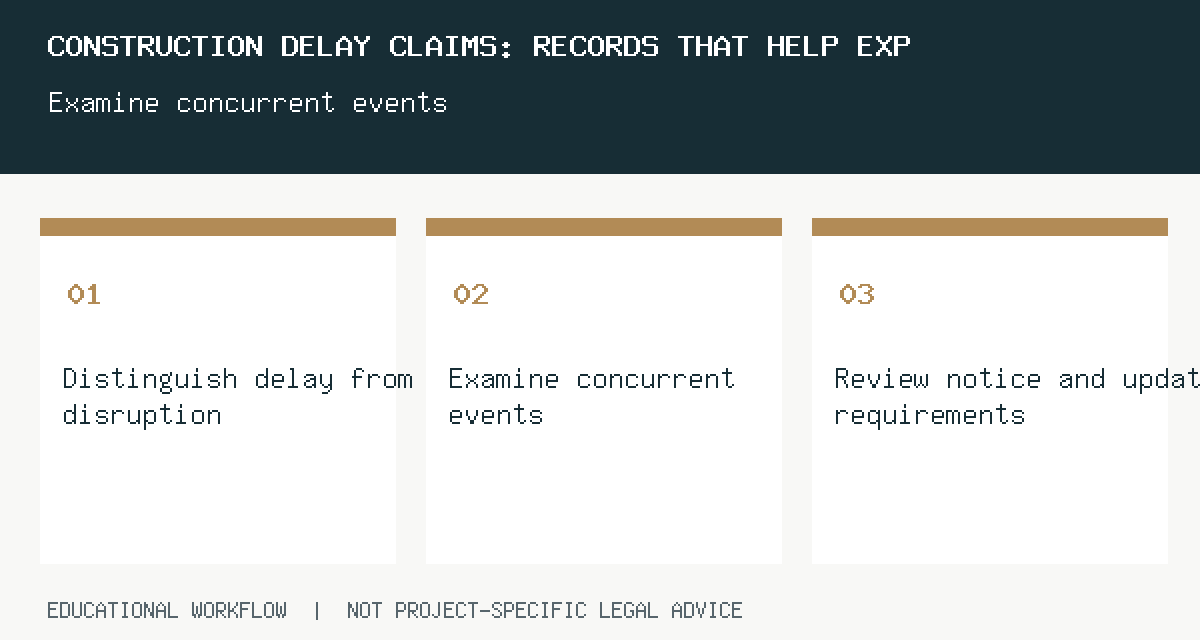
Distinguish delay from disruption
An activity can become more expensive or less productive without moving the completion milestone.
Track re-sequencing, stacking of trades, overtime, repeated mobilization, lost productivity and work-arounds separately. This helps preserve credibility.
A contractor may keep a completion date by accelerating, while incurring documented additional resources to do so.
Do not label every inefficiency a critical-path delay or every delayed task a project-wide extension. Not every disagreement warrants a formal claim.
Examine concurrent events
Two or more independent causes can affect the same period; the contract and applicable law influence allocation. The question is not simply whether someone believes examine concurrent events matters; it is which documents support the conclusion and which facts are still disputed. Not every disagreement warrants a formal claim.
Compare overlapping events by date and impacted activities, documenting known uncertainties rather than assigning blame too quickly. Consider the perspective of each project participant.
An owner instruction might coincide with a subcontractor’s unavailable crew, requiring a more careful sequence analysis.
Avoid claiming full responsibility of another party based solely on one event’s calendar date. Financial summaries should reconcile with the source material. Where the parties disagree, label the disagreement.
Review notice and update requirements
Contracts can require prompt notice of emerging delay, contemporaneous schedule updates and specific supporting information. Financial summaries should reconcile with the source material. Where the parties disagree, label the disagreement.
Map each contractual notice requirement to actual letters, emails, meeting minutes and delivery confirmations.
A claim submitted months after the event may raise a different issue from an earlier reservation of rights.
Do not assume internal team chat messages automatically satisfy a contract’s designated notice procedure.
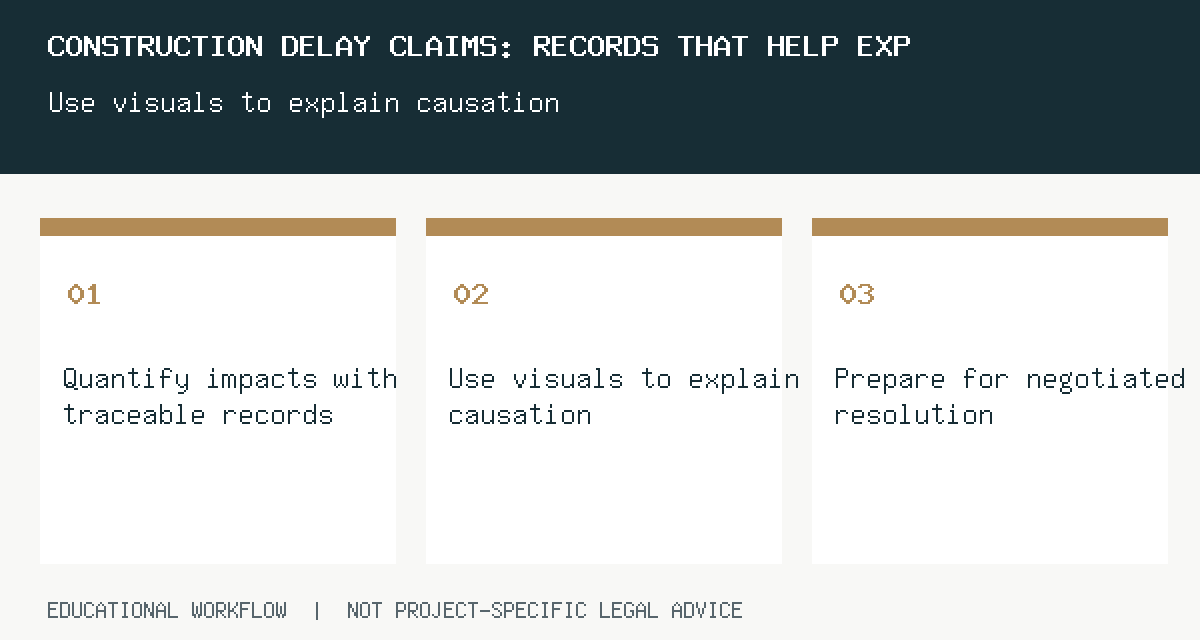
Quantify impacts with traceable records
The amount claimed may reflect labor, equipment, supervision, escalation, overhead or extended duration, each with different proof.
Tie proposed damages to invoices, cost codes, labor records, invoices from suppliers and a method of calculation. The question is not simply whether someone believes quantify impacts with traceable records matters; it is which documents support the conclusion and which facts are still disputed. This helps preserve credibility.
A spreadsheet should show the source for its assumptions and distinguish actual costs from estimates.
Avoid adding costs twice when the same overhead or time element is included in multiple claim categories. Not every disagreement warrants a formal claim.
Use visuals to explain causation
A clear timeline, milestone comparison or sequence diagram can help non-schedulers understand competing narratives. Not every disagreement warrants a formal claim.
Create a visual that connects event dates, decisions, affected activities, mitigation actions and the resulting project milestone. Consider the perspective of each project participant.
An annotated schedule excerpt can show why a late delivery affected one trade but not another.
Do not hide uncertainty or omit events that weaken a favored narrative. Financial summaries should reconcile with the source material. Where the parties disagree, label the disagreement.
Prepare for negotiated resolution
Effective discussions identify which dates and costs are undisputed before debating legal entitlement. The question is not simply whether someone believes prepare for negotiated resolution matters; it is which documents support the conclusion and which facts are still disputed. Financial summaries should reconcile with the source material. Where the parties disagree, label the disagreement.
Assemble a concise chronology, baseline and updated schedules, event backup, cost summary and unresolved questions for decision-makers.
A focused meeting may resolve the length of an impact while leaving the rate for extra resources open for later review.
Do not sign a global release without understanding what associated claims and defenses the language covers.
Project record checklist
- Start with the contract and baseline schedule: Retain the approved baseline schedule, contract calendar, milestone definitions, float conventions and schedule-submission correspondence.
- Build a dated event register: List each event by start date, end date, affected location, workstream, notice, source document and stated impact.
- Preserve daily production evidence: Collect signed field diaries, photos, labor reports, delivery logs, meeting notes and subcontractor reports alongside the schedule.
- Distinguish delay from disruption: Track re-sequencing, stacking of trades, overtime, repeated mobilization, lost productivity and work-arounds separately.
- Examine concurrent events: Compare overlapping events by date and impacted activities, documenting known uncertainties rather than assigning blame too quickly.
- Review notice and update requirements: Map each contractual notice requirement to actual letters, emails, meeting minutes and delivery confirmations.
- Quantify impacts with traceable records: Tie proposed damages to invoices, cost codes, labor records, invoices from suppliers and a method of calculation.
- Use visuals to explain causation: Create a visual that connects event dates, decisions, affected activities, mitigation actions and the resulting project milestone.
- Prepare for negotiated resolution: Assemble a concise chronology, baseline and updated schedules, event backup, cost summary and unresolved questions for decision-makers.
Questions people often ask
Does finishing after the contract date prove a compensable delay?
No. The factual causes, contractual allocation of risk, schedule impact and applicable law all matter. The applicable agreement, contemporaneous records and particular project facts should be reviewed before making an irreversible decision.
Are weather days automatically excusable?
Not universally. Look to the agreement, weather records, notice obligations and actual schedule effects.
What is a critical path?
It is a sequence of activities that influences project completion; its evaluation may change as the job progresses.
When should the schedule be updated?
Follow the contract’s requirements and preserve each issued version with its supporting progress information.
Related construction law guidance
- Mechanics liens and payment rights
- Construction contracts and disputes
- Project claims and resolution
- Discuss the issue with construction counsel
For an independent reference, review California Courts civil discovery guide.
Legal information only, not legal advice. Requirements, defenses, and deadlines depend on the contract, project, jurisdiction and facts. Viewing this page does not create an attorney-client relationship. Consult qualified counsel about your circumstances.
Discuss your construction law matter
Construction disputes are fact-specific. Share the project background and learn how a focused legal review can help clarify your next decision.