
Construction Change Order Disputes: How to Build a Defensible Paper Trail
A step-by-step construction change order documentation guide for owners, contractors, and subcontractors dealing with scope changes and extra-work claims.
A project often changes long before its paperwork does. A field instruction, an unexpected site condition, or a revised drawing can create new labor, materials, schedule pressure, and disagreement about price. The difficulty is not simply documenting an extra task; it is connecting the request, authorization, price, performance and timing in a way all parties can understand. The practices below explain how to organize the record without assuming that an email, verbal instruction, or signed form has the same effect on every construction contract.
Key idea: A careful factual record protects decision-making even when the parties disagree about legal responsibility. Use the steps below as a working framework, not a substitute for project-specific advice.
Establish the baseline scope
Change disputes are hard to assess when no one can say precisely what the original contract included. The question is not simply whether someone believes establish the baseline scope matters; it is which documents support the conclusion and which facts are still disputed. An effective project record is designed for somebody who was not present when the events occurred. Dates, document authors, the version of a drawing, and the reason an action was taken should all remain visible. When the parties later discuss a claim, that context makes it easier to distinguish a contemporaneous fact from a retrospective interpretation.
Gather signed agreements, drawings, specifications, inclusions, exclusions, allowances and accepted bid clarifications; identify the controlling versions. The strongest explanation separates the observed event from later assumptions. That distinction makes discussions about money, schedule and responsibility easier to follow. An efficient review begins with the question being answered, not the size of the document collection. Group the material by topic and cross-reference it to a chronology. If a key record is missing, identify the gap openly instead of allowing an assumption to stand in for evidence. This helps preserve credibility.
A concrete subcontract might mention site preparation generally while a drawing revision adds a new footing detail with substantial implications. Project teams are often under pressure to reach an immediate operational answer. The decision to keep work moving can coexist with a written record that a price, deadline, or contractual issue remains unresolved. Clear written reservations are more useful than vague language implying the parties already reached agreement.
Avoid comparing the changed work only to a verbal understanding or an outdated set of drawings. Not every disagreement warrants a formal claim. Many can be narrowed through a targeted request for documents, a meeting of responsible decision-makers, or an agreed technical review. The choice depends on the agreement, the potential financial impact, available evidence, and the risk of letting an applicable deadline pass.
Trace who requested the change
Field personnel can identify useful work without necessarily possessing contractual authority to approve added cost. Read this issue alongside the signed contract and the actual sequence of work. A sensible next step may differ for a property owner, a direct contractor, and a subcontractor. Not every disagreement warrants a formal claim.
Log the requesting person, date, medium, location, work description, and the contract provision concerning approval authority. A useful working file makes the answer auditable: the reader can see the original record, the date, the person involved, and what changed afterward. Consider the perspective of each project participant. The owner may focus on financing, safety and completion; a contractor may focus on sequence, cash flow and contract administration; a subcontractor may focus on access and timely payment. Their objectives differ, but an accurate shared factual record can improve the conversation.
A superintendent’s text about moving a wall could establish a factual instruction while leaving the pricing authorization question unresolved. The most useful documents often predate the dispute: approved plans, dated notes, routine status reports and formal notices. Preserve originals, maintain reliable backups and avoid rewriting the past to fit a later narrative. A transparent correction note is preferable to quietly changing the underlying record.
Do not assume job-site urgency eliminates notice provisions or transfers authority to anyone present. Financial summaries should reconcile with the source material. An amount marked requested, approved, invoiced, paid or withheld has a different meaning. Where the parties disagree, label the disagreement. Never present an estimate as a paid cost or a proposed change as an executed amendment.
Capture the before-and-after condition
Photographs and contemporaneous plans can show why an added task differs from the original scope. Financial summaries should reconcile with the source material. Where the parties disagree, label the disagreement.
Use dated site photos, sketches, marked-up plans, daily reports, and clear location references before altered conditions become concealed. The question is not simply whether someone believes capture the before-and-after condition matters; it is which documents support the conclusion and which facts are still disputed. Before sending a strongly worded response, identify which statements can be supported and what questions remain open. An accurate, restrained letter can reserve an issue without escalating every factual uncertainty into an accusation. Appropriate communication strategy depends on both the commercial relationship and the legal setting.
An underground obstruction may become impossible to photograph once excavation is backfilled and equipment has moved. Build a decision calendar with dates for follow-up, missing documents, meetings and any potentially applicable notices. Because construction deadlines can be highly specific and event-driven, have qualified counsel review the contract and relevant law rather than relying solely on a generic administrative calendar.
Avoid captions that overstate what an image proves; retain original file timestamps and context.
Price the actual change
A vague single number can conceal whether the dispute concerns quantities, rates, equipment, markup or schedule disruption.
Separate labor, materials, rentals, equipment time, subcontractor quotes, supervision, overhead and any contract-authorized markup. This helps preserve credibility.
A pricing worksheet showing revised quantities may allow agreement on most of a change even when an equipment charge remains disputed.
Do not treat customary rates as automatically contractually allowed; check the method the agreement specifies. Not every disagreement warrants a formal claim.
Separate notice from final approval
A notice of potential change can preserve a record without establishing that a price or time extension was accepted. The question is not simply whether someone believes separate notice from final approval matters; it is which documents support the conclusion and which facts are still disputed. Not every disagreement warrants a formal claim.
Use distinct fields for notice submitted, estimate sent, direction received, authorization recorded, and final change order executed. Consider the perspective of each project participant.
A field team might proceed under a written directive while the commercial team continues negotiating compensation.
Avoid labeling an unexecuted estimate as an approved change in reports or payment applications. Financial summaries should reconcile with the source material. Where the parties disagree, label the disagreement.
Measure schedule effects realistically
Extra work does not always produce a project delay; its effect depends on sequencing, available float and other concurrent activities. Financial summaries should reconcile with the source material. Where the parties disagree, label the disagreement.
Record when the change occurred, affected predecessors and successors, crew availability, and any revised critical-path evaluation.
A design change might be costly but occur off the critical path, while a late access restriction could affect the completion sequence.
Do not assume every additional day worked equates to an excusable extension or compensable delay.
Prevent inconsistent communications
Email chains, meeting minutes, daily reports and accounting entries can tell different stories if not coordinated.
Keep a single change log with identifiers that connect to all related documents; circulate meeting minutes for confirmation. The question is not simply whether someone believes prevent inconsistent communications matters; it is which documents support the conclusion and which facts are still disputed. This helps preserve credibility.
If a change is marked rejected in the tracker but still appears in the next draw request, the inconsistency will complicate negotiations.
Do not rewrite historical records to make them agree; add an explanatory correction and preserve the originals. Not every disagreement warrants a formal claim.
Evaluate partial agreement and closeout
Parties can often narrow disputes by isolating work everyone accepts from disputed cost or time impacts. Not every disagreement warrants a formal claim.
Record approved quantities, credits, contested rates, pending documentation and the effect on the remaining contract balance. Consider the perspective of each project participant.
An owner and subcontractor may agree a relocation was directed but need more records before resolving acceleration charges.
Avoid forcing an all-or-nothing conclusion when a careful reconciliation can identify undisputed portions. Financial summaries should reconcile with the source material. Where the parties disagree, label the disagreement.
Know when legal review is useful
Formal claim procedures, waiver language and disputed authorization rules may affect legal options beyond everyday project administration. The question is not simply whether someone believes know when legal review is useful matters; it is which documents support the conclusion and which facts are still disputed. Financial summaries should reconcile with the source material. Where the parties disagree, label the disagreement.
Bring counsel the baseline contract, change log, communications, current payment position, and any pending notice deadlines.
Early review before a final waiver or settlement can identify terms that might resolve one issue while inadvertently releasing another.
Do not assume a project manager’s commercial compromise automatically satisfies all contractual or legal requirements.
Project record checklist
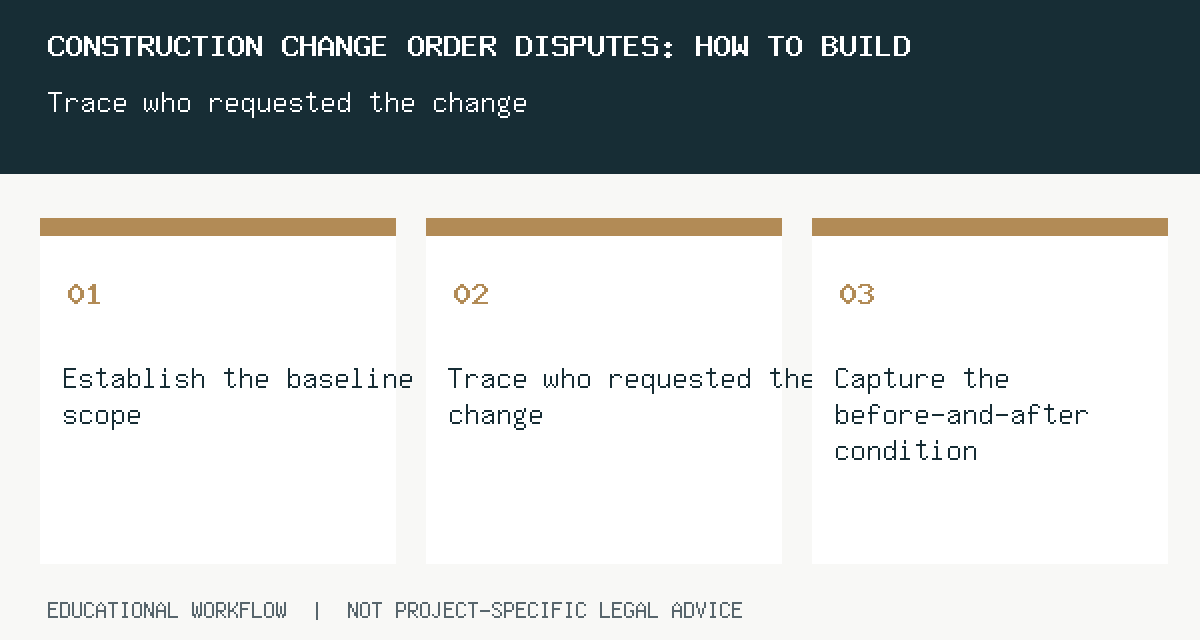
- Establish the baseline scope: Gather signed agreements, drawings, specifications, inclusions, exclusions, allowances and accepted bid clarifications; identify the controlling versions.
- Trace who requested the change: Log the requesting person, date, medium, location, work description, and the contract provision concerning approval authority.
- Capture the before-and-after condition: Use dated site photos, sketches, marked-up plans, daily reports, and clear location references before altered conditions become concealed.
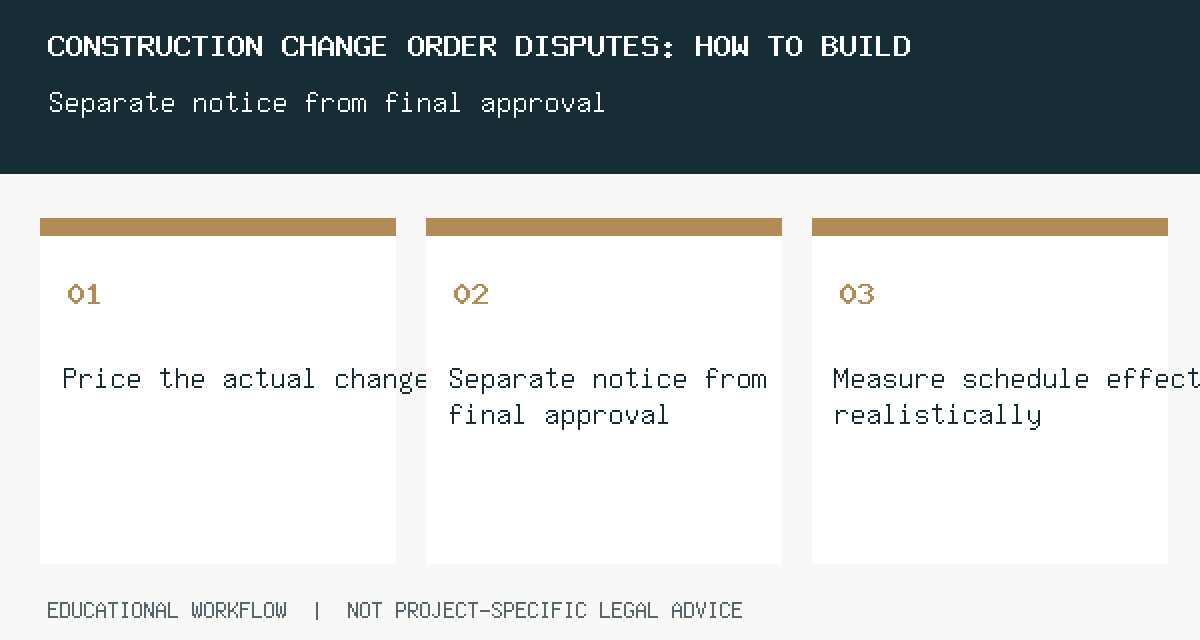
- Price the actual change: Separate labor, materials, rentals, equipment time, subcontractor quotes, supervision, overhead and any contract-authorized markup.
- Separate notice from final approval: Use distinct fields for notice submitted, estimate sent, direction received, authorization recorded, and final change order executed.
- Measure schedule effects realistically: Record when the change occurred, affected predecessors and successors, crew availability, and any revised critical-path evaluation.
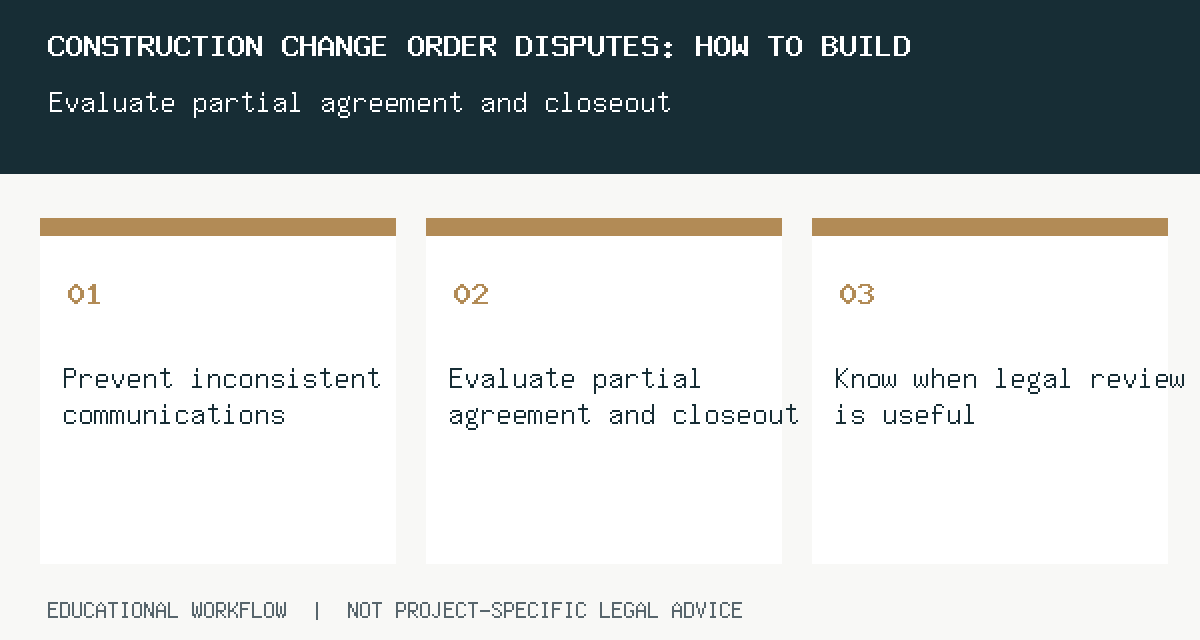
- Prevent inconsistent communications: Keep a single change log with identifiers that connect to all related documents; circulate meeting minutes for confirmation.
- Evaluate partial agreement and closeout: Record approved quantities, credits, contested rates, pending documentation and the effect on the remaining contract balance.
- Know when legal review is useful: Bring counsel the baseline contract, change log, communications, current payment position, and any pending notice deadlines.
Questions people often ask
Is a verbal instruction automatically a valid change order?
No single answer applies. Contract language, applicable law and the parties’ conduct can affect the analysis. The applicable agreement, contemporaneous records and particular project facts should be reviewed before making an irreversible decision.
What should be documented before changed work is concealed?
Preserve dated photographs, revised plans, the instruction, quantity measurements and supporting daily records.
Can the parties agree on cost without agreeing on time?
They can discuss or document partial agreements, but the wording should be clear about which issues remain open.
Should every change be treated as a claim?
Not necessarily. A consistent management process can resolve many changes before they become formal disputes.
Related construction law guidance
- Mechanics liens and payment rights
- Construction contracts and disputes
- Project claims and resolution
- Discuss the issue with construction counsel
For an independent reference, review California CSLB consumer contract guidance.
Legal information only, not legal advice. Requirements, defenses, and deadlines depend on the contract, project, jurisdiction and facts. Viewing this page does not create an attorney-client relationship. Consult qualified counsel about your circumstances.
Discuss your construction law matter
Construction disputes are fact-specific. Share the project background and learn how a focused legal review can help clarify your next decision.