
Subcontractor Scope Gaps: How to Prevent Disputes Between Trades
A guide to trade boundaries, scope exclusions, drawing conflicts, coordination meetings and documenting disputed subcontractor responsibilities.
Not every construction disagreement is about whether work was done well. Many disputes begin because two trades each believe the other was supposed to perform a small but critical task. A missing penetration seal, temporary power connection, access panel or final testing step can stall a whole sequence. Scope gaps are especially expensive when the building is nearly complete. This guide explains how to detect them early and document a fair, workable response when contractors and subcontractors disagree.
Key idea: A careful factual record protects decision-making even when the parties disagree about legal responsibility. Use the steps below as a working framework, not a substitute for project-specific advice.
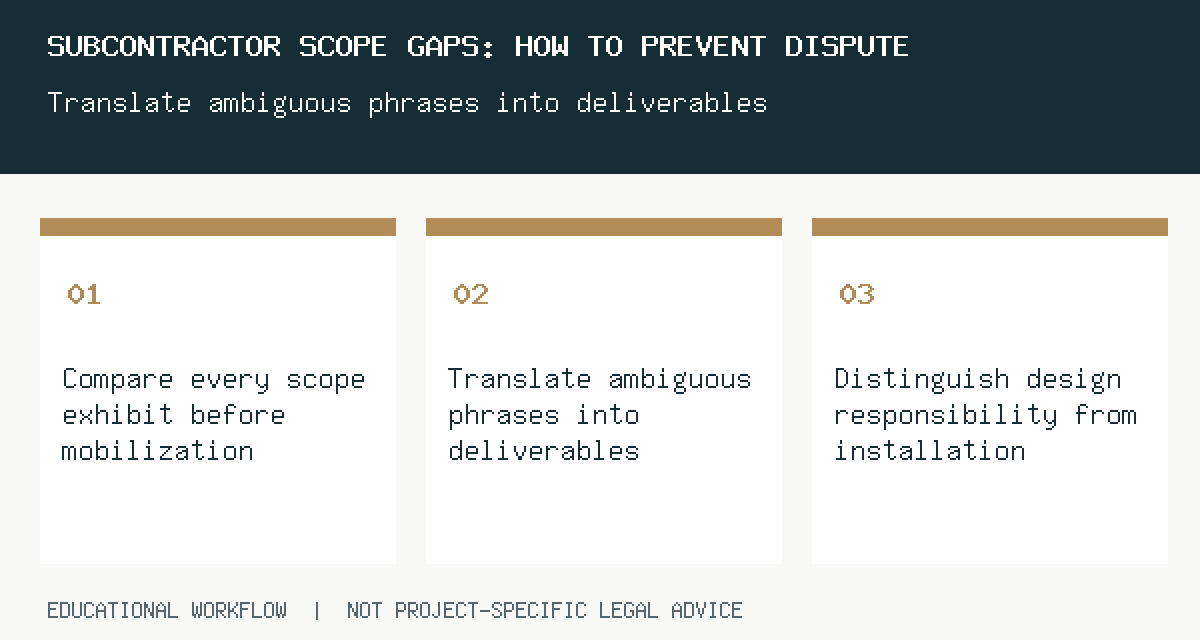
Compare every scope exhibit before mobilization
A subcontract may incorporate plans and specifications while also listing trade-specific inclusions and exclusions that appear inconsistent. The question is not simply whether someone believes compare every scope exhibit before mobilization matters; it is which documents support the conclusion and which facts are still disputed. An effective project record is designed for somebody who was not present when the events occurred. Dates, document authors, the version of a drawing, and the reason an action was taken should all remain visible. When the parties later discuss a claim, that context makes it easier to distinguish a contemporaneous fact from a retrospective interpretation.
Build a responsibility matrix across the prime contract, trade scopes, bid clarifications, schedules and relevant technical details. The strongest explanation separates the observed event from later assumptions. That distinction makes discussions about money, schedule and responsibility easier to follow. An efficient review begins with the question being answered, not the size of the document collection. Group the material by topic and cross-reference it to a chronology. If a key record is missing, identify the gap openly instead of allowing an assumption to stand in for evidence. This helps preserve credibility.
Electrical and mechanical subcontractors may each assume another party is furnishing a power connection for equipment. Project teams are often under pressure to reach an immediate operational answer. The decision to keep work moving can coexist with a written record that a price, deadline, or contractual issue remains unresolved. Clear written reservations are more useful than vague language implying the parties already reached agreement.
Avoid assuming a familiar industry custom replaces what the executed agreement actually says. Not every disagreement warrants a formal claim. Many can be narrowed through a targeted request for documents, a meeting of responsible decision-makers, or an agreed technical review. The choice depends on the agreement, the potential financial impact, available evidence, and the risk of letting an applicable deadline pass.
Translate ambiguous phrases into deliverables
Terms like complete system, by others or incidental work can conceal tasks with measurable cost and coordination implications. Read this issue alongside the signed contract and the actual sequence of work. A sensible next step may differ for a property owner, a direct contractor, and a subcontractor. Not every disagreement warrants a formal claim.
Identify the exact item, location, performance standard, testing responsibility and party responsible for each handoff. A useful working file makes the answer auditable: the reader can see the original record, the date, the person involved, and what changed afterward. Consider the perspective of each project participant. The owner may focus on financing, safety and completion; a contractor may focus on sequence, cash flow and contract administration; a subcontractor may focus on access and timely payment. Their objectives differ, but an accurate shared factual record can improve the conversation.
A storefront package may include glazing but exclude blocking, sealant or temporary protection unless the scope specifies them. The most useful documents often predate the dispute: approved plans, dated notes, routine status reports and formal notices. Preserve originals, maintain reliable backups and avoid rewriting the past to fit a later narrative. A transparent correction note is preferable to quietly changing the underlying record.
Do not rely on a broad label when an item can be described with a drawing reference and acceptance criterion. Financial summaries should reconcile with the source material. An amount marked requested, approved, invoiced, paid or withheld has a different meaning. Where the parties disagree, label the disagreement. Never present an estimate as a paid cost or a proposed change as an executed amendment.
Distinguish design responsibility from installation
Some subcontracts require installation only; others allocate engineering, shop drawings or delegated design responsibilities. Financial summaries should reconcile with the source material. Where the parties disagree, label the disagreement.
Record who prepares, reviews and approves submittals, calculations, product data and field adjustments. The question is not simply whether someone believes distinguish design responsibility from installation matters; it is which documents support the conclusion and which facts are still disputed. Before sending a strongly worded response, identify which statements can be supported and what questions remain open. An accurate, restrained letter can reserve an issue without escalating every factual uncertainty into an accusation. Appropriate communication strategy depends on both the commercial relationship and the legal setting.
A trade might install an engineered connection while another party retains responsibility for approving its design assumptions. Build a decision calendar with dates for follow-up, missing documents, meetings and any potentially applicable notices. Because construction deadlines can be highly specific and event-driven, have qualified counsel review the contract and relevant law rather than relying solely on a generic administrative calendar.
Avoid treating a shop drawing review stamp as an unlimited transfer of liability or contract scope.
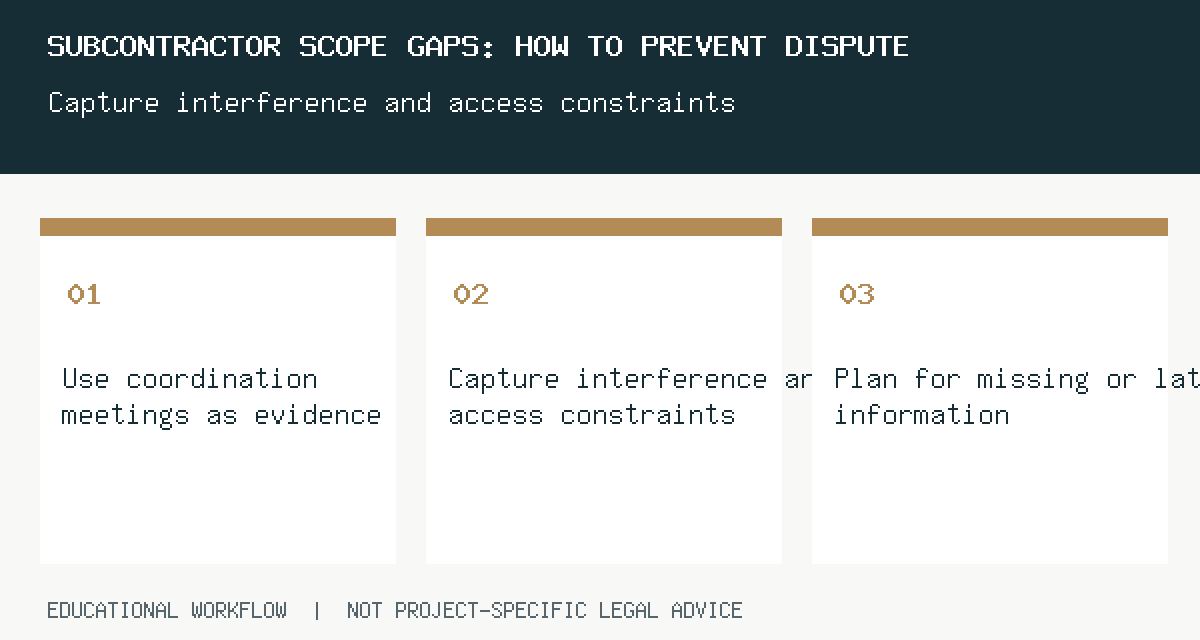
Use coordination meetings as evidence
Meetings can resolve sequencing and responsibility, but verbal agreements are difficult to verify later.
Record decisions, responsible parties, target dates and unresolved issues; circulate notes promptly and preserve responses. This helps preserve credibility.
A coordination meeting might assign a temporary access platform while leaving permanent support design unresolved.
Do not convert an unresolved discussion into a claimed approval in the official action log. Not every disagreement warrants a formal claim.
Capture interference and access constraints
Trades may lose productivity when work areas are unavailable or another system occupies planned space. The question is not simply whether someone believes capture interference and access constraints matters; it is which documents support the conclusion and which facts are still disputed. Not every disagreement warrants a formal claim.
Maintain dated photographs, clash reports, access notices, daily logs and the sequence for corrective work. Consider the perspective of each project participant.
A plumbing crew may need to remobilize after discovering that a duct installation blocks its planned route.
Avoid attributing every interference to negligence without first checking coordinated drawings and authorized changes. Financial summaries should reconcile with the source material. Where the parties disagree, label the disagreement.
Plan for missing or late information
Subcontractors sometimes discover that a detail, dimension or performance criterion is absent when work approaches installation. Financial summaries should reconcile with the source material. Where the parties disagree, label the disagreement.
Send an organized RFI identifying the specific conflict, relevant drawings and the date the answer is needed.
An RFI describing two conflicting elevations is more actionable than a vague request for clarification.
Do not imply that every delay following an RFI is automatically compensable or caused by the reviewing party.
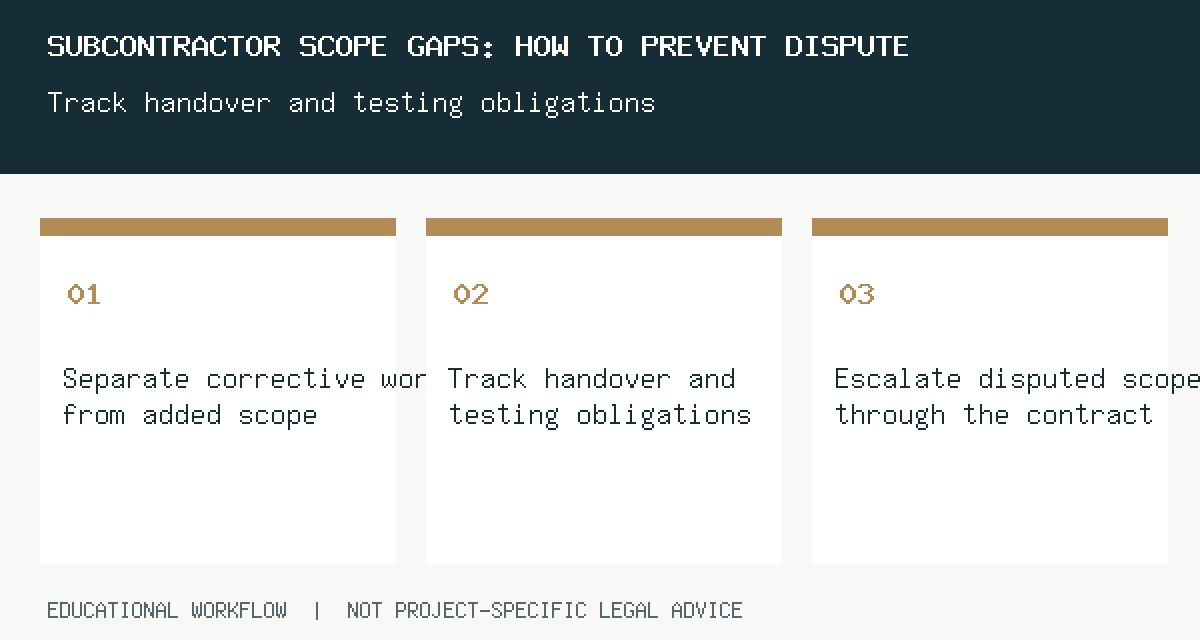
Separate corrective work from added scope
Fixing defective or incomplete contracted work differs from performing a new task outside the agreed scope.
Document the alleged deficiency, applicable standard, original scope and instruction to perform additional work. The question is not simply whether someone believes separate corrective work from added scope matters; it is which documents support the conclusion and which facts are still disputed. This helps preserve credibility.
A project team may agree a rough-in failed inspection but dispute whether new routing reflects a design change.
Avoid negotiating cost before establishing what actually changed or failed to meet the agreed requirement. Not every disagreement warrants a formal claim.
Track handover and testing obligations
Commissioning and closeout commonly involve multiple trades, making responsibility hard to reconstruct late in the project. Not every disagreement warrants a formal claim.
Create a test-and-handover matrix for inspections, startup, documentation, warranties, training and final signoff. Consider the perspective of each project participant.
One trade might install controls while another must witness testing and provide the operations manual.
Do not mark an item complete based only on installation when contractual commissioning or paperwork is outstanding. Financial summaries should reconcile with the source material. Where the parties disagree, label the disagreement.
Escalate disputed scope through the contract
When teams disagree, the next step should preserve working relationships while keeping rights and deadlines visible. The question is not simply whether someone believes escalate disputed scope through the contract matters; it is which documents support the conclusion and which facts are still disputed. Financial summaries should reconcile with the source material. Where the parties disagree, label the disagreement.
Present the contract references, scope matrix, dated correspondence, cost estimate and proposed interim direction.
A documented temporary assignment may allow work to continue while parties reserve the pricing question for review.
Do not have field staff unknowingly sign documents that waive unresolved payment or delay issues.
Project record checklist
- Compare every scope exhibit before mobilization: Build a responsibility matrix across the prime contract, trade scopes, bid clarifications, schedules and relevant technical details.
- Translate ambiguous phrases into deliverables: Identify the exact item, location, performance standard, testing responsibility and party responsible for each handoff.
- Distinguish design responsibility from installation: Record who prepares, reviews and approves submittals, calculations, product data and field adjustments.
- Use coordination meetings as evidence: Record decisions, responsible parties, target dates and unresolved issues; circulate notes promptly and preserve responses.
- Capture interference and access constraints: Maintain dated photographs, clash reports, access notices, daily logs and the sequence for corrective work.
- Plan for missing or late information: Send an organized RFI identifying the specific conflict, relevant drawings and the date the answer is needed.
- Separate corrective work from added scope: Document the alleged deficiency, applicable standard, original scope and instruction to perform additional work.
- Track handover and testing obligations: Create a test-and-handover matrix for inspections, startup, documentation, warranties, training and final signoff.
- Escalate disputed scope through the contract: Present the contract references, scope matrix, dated correspondence, cost estimate and proposed interim direction.
Questions people often ask
What is a subcontract scope gap?
It is work or responsibility that the parties have not clearly allocated between their contracts, exhibits and project processes. The applicable agreement, contemporaneous records and particular project facts should be reviewed before making an irreversible decision.
Does an RFI automatically entitle a contractor to extra payment?
No. It documents a question; entitlement depends on contractual duties, facts and applicable law.
Can a scope matrix replace subcontract language?
A matrix can help administration, but contractual priority and amendment requirements still matter.
What should be done when a dispute threatens the schedule?
Document the issue and consider a written interim direction consistent with the contract while obtaining advice.
Related construction law guidance
- Mechanics liens and payment rights
- Construction contracts and disputes
- Project claims and resolution
- Discuss the issue with construction counsel
For an independent reference, review California CSLB contractor contract resources.
Legal information only, not legal advice. Requirements, defenses, and deadlines depend on the contract, project, jurisdiction and facts. Viewing this page does not create an attorney-client relationship. Consult qualified counsel about your circumstances.
Discuss your construction law matter
Construction disputes are fact-specific. Share the project background and learn how a focused legal review can help clarify your next decision.