
Construction Defect Allegations: A Practical First-Response Guide for Owners and Contractors
Learn how to preserve evidence, document damage, review contracts and insurance, organize inspections and respond to construction defect allegations.
A leak, crack, failed inspection or performance complaint does not by itself identify the responsible party or the legal remedy. Design issues, installation practices, product problems, maintenance, later modifications and site conditions can overlap. Early steps matter because repairs can disturb evidence, communications can affect relationships, and insurance or contract terms may impose requirements. This guide gives property owners, contractors and construction teams a disciplined first-response framework for documenting a suspected defect while protecting health and safety.
Key idea: A careful factual record protects decision-making even when the parties disagree about legal responsibility. Use the steps below as a working framework, not a substitute for project-specific advice.
Address immediate safety and damage
Water intrusion, unstable structures, exposed wiring or similar conditions may require immediate protective action. The question is not simply whether someone believes address immediate safety and damage matters; it is which documents support the conclusion and which facts are still disputed. An effective project record is designed for somebody who was not present when the events occurred. Dates, document authors, the version of a drawing, and the reason an action was taken should all remain visible. When the parties later discuss a claim, that context makes it easier to distinguish a contemporaneous fact from a retrospective interpretation.
Prioritize personal safety and reasonable mitigation; record what was done, by whom, when and why. The strongest explanation separates the observed event from later assumptions. That distinction makes discussions about money, schedule and responsibility easier to follow. An efficient review begins with the question being answered, not the size of the document collection. Group the material by topic and cross-reference it to a chronology. If a key record is missing, identify the gap openly instead of allowing an assumption to stand in for evidence. This helps preserve credibility.
If a leak threatens equipment, temporary water isolation or protective covering may be necessary before a full investigation. Project teams are often under pressure to reach an immediate operational answer. The decision to keep work moving can coexist with a written record that a price, deadline, or contractual issue remains unresolved. Clear written reservations are more useful than vague language implying the parties already reached agreement.
Do not delay urgent mitigation merely to preserve a perfect inspection scene; document the condition as safely as possible. Not every disagreement warrants a formal claim. Many can be narrowed through a targeted request for documents, a meeting of responsible decision-makers, or an agreed technical review. The choice depends on the agreement, the potential financial impact, available evidence, and the risk of letting an applicable deadline pass.
Describe the observed condition neutrally
Words like defective construction or negligent installation may imply conclusions before a technical investigation exists. Read this issue alongside the signed contract and the actual sequence of work. A sensible next step may differ for a property owner, a direct contractor, and a subcontractor. Not every disagreement warrants a formal claim.
Write what was observed, where, when, weather conditions, affected materials and whether the condition recurs. A useful working file makes the answer auditable: the reader can see the original record, the date, the person involved, and what changed afterward. Consider the perspective of each project participant. The owner may focus on financing, safety and completion; a contractor may focus on sequence, cash flow and contract administration; a subcontractor may focus on access and timely payment. Their objectives differ, but an accurate shared factual record can improve the conversation.
A homeowner can document water staining beneath a window without claiming the flashing was necessarily installed incorrectly. The most useful documents often predate the dispute: approved plans, dated notes, routine status reports and formal notices. Preserve originals, maintain reliable backups and avoid rewriting the past to fit a later narrative. A transparent correction note is preferable to quietly changing the underlying record.
Avoid exaggeration, blame-focused messages or mixing first-hand observations with theories that have not been tested. Financial summaries should reconcile with the source material. An amount marked requested, approved, invoiced, paid or withheld has a different meaning. Where the parties disagree, label the disagreement. Never present an estimate as a paid cost or a proposed change as an executed amendment.
Preserve original photographs and physical evidence
Photos, failed parts, samples and measurements may become important in understanding causation and scope of damage. Financial summaries should reconcile with the source material. Where the parties disagree, label the disagreement.
Take wide-angle and detail photographs, retain timestamps and keep removed material labeled when safe and appropriate. The question is not simply whether someone believes preserve original photographs and physical evidence matters; it is which documents support the conclusion and which facts are still disputed. Before sending a strongly worded response, identify which statements can be supported and what questions remain open. An accurate, restrained letter can reserve an issue without escalating every factual uncertainty into an accusation. Appropriate communication strategy depends on both the commercial relationship and the legal setting.
A damaged pipe fitting that is discarded after replacement may deprive investigators of a useful source of information. Build a decision calendar with dates for follow-up, missing documents, meetings and any potentially applicable notices. Because construction deadlines can be highly specific and event-driven, have qualified counsel review the contract and relevant law rather than relying solely on a generic administrative calendar.
Do not alter electronic metadata or dispose of material that may reasonably be relevant to a dispute.
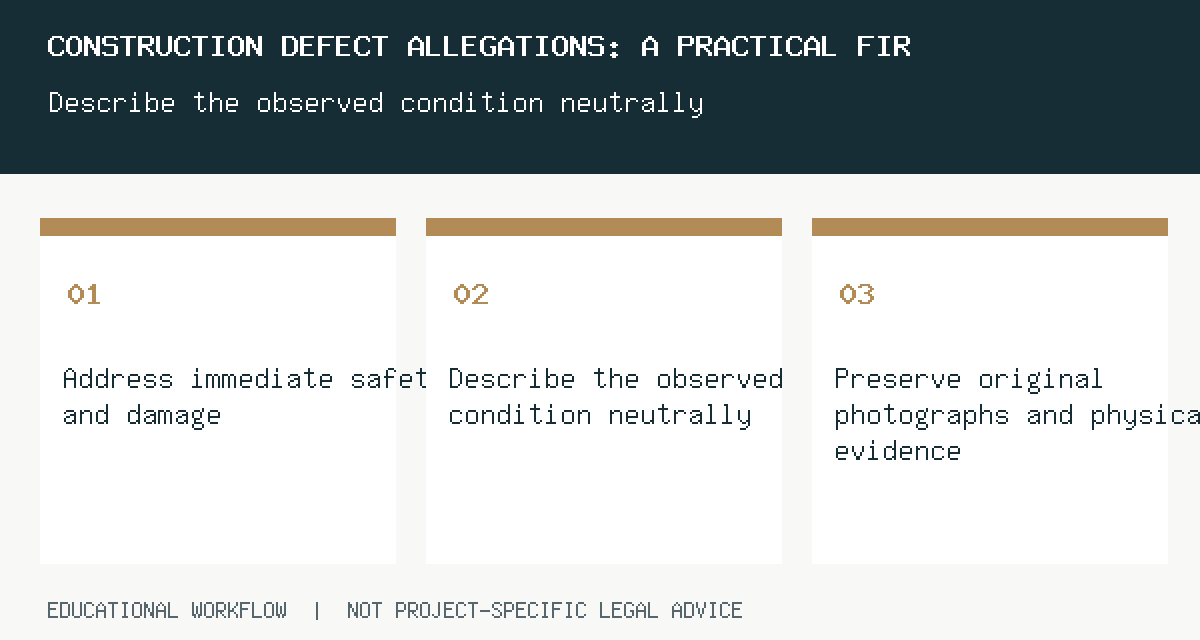
Collect the design and construction record
Responsibility cannot be evaluated without understanding what was specified, approved, substituted and actually built.
Gather contracts, plans, specifications, submittals, RFIs, change orders, inspections, warranties and relevant maintenance records. This helps preserve credibility.
An approved alternate product may meet the specification differently from the originally detailed component.
Avoid treating a single plan sheet as the complete statement of every party’s obligations. Not every disagreement warrants a formal claim.
Map notice and insurance obligations
Contracts, policies and sometimes statutes may contain notice or process requirements that apply to allegations. The question is not simply whether someone believes map notice and insurance obligations matters; it is which documents support the conclusion and which facts are still disputed. Not every disagreement warrants a formal claim.
Identify relevant parties, notice recipients, policy information, discovery dates and communications already sent. Consider the perspective of each project participant.
An owner may contact a general contractor while a subcontract requires separate notice to a particular address.
Do not assume that an informal call satisfies an insurer’s reporting rule or a contract’s designated method. Financial summaries should reconcile with the source material. Where the parties disagree, label the disagreement.
Plan a focused technical inspection
An inspection is more useful when it distinguishes observable damage from possible causes and records its limits. Financial summaries should reconcile with the source material. Where the parties disagree, label the disagreement.
Set a scope, invite appropriate participants when advised, record conditions and identify where testing may disturb materials.
A moisture survey may locate affected areas without conclusively identifying the route water took into the assembly.
Avoid asking a single expert to decide every legal issue; technical and legal questions are distinct.
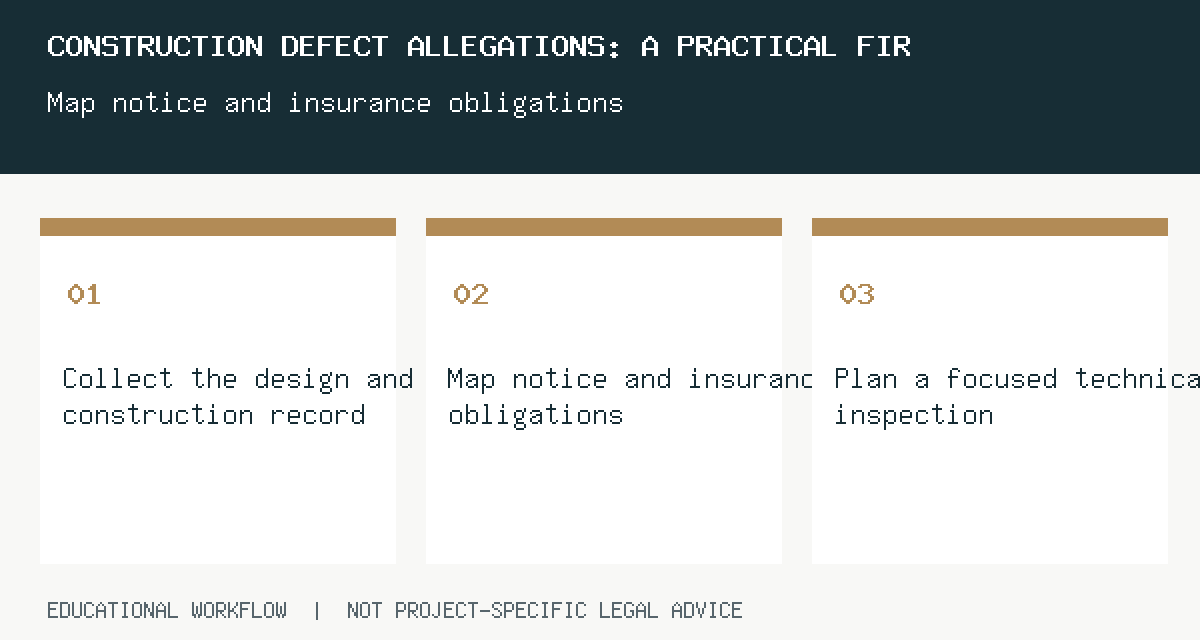
Separate repair planning from liability positions
Immediate remediation and eventual allocation of responsibility are related but not identical.
Document temporary work, obtain reasoned repair options, preserve estimates and identify work that may affect evidence. The question is not simply whether someone believes separate repair planning from liability positions matters; it is which documents support the conclusion and which facts are still disputed. This helps preserve credibility.
A building may require prompt drying and temporary sealing while the parties later dispute whether design or installation caused entry.
Do not demand that occupants tolerate unsafe conditions while an abstract fault debate continues. Not every disagreement warrants a formal claim.
Identify limitations and warranty questions
Potential contract claims, warranty provisions and statutory deadlines may follow different starting points or exceptions. Not every disagreement warrants a formal claim.
Prepare dates for completion, discovery, prior complaints, previous repairs and relevant contractual promises for legal review. Consider the perspective of each project participant.
A defect noticed years later may raise different questions from a condition recorded during the original punch-list walk.
Do not calculate a limitations period from a general blog post or assume the discovery date is always decisive. Financial summaries should reconcile with the source material. Where the parties disagree, label the disagreement.
Work toward a documented resolution
A practical response clarifies what needs investigation, what can be fixed now and what issues remain disputed. The question is not simply whether someone believes work toward a documented resolution matters; it is which documents support the conclusion and which facts are still disputed. Financial summaries should reconcile with the source material. Where the parties disagree, label the disagreement.
Use a deficiency log, inspection findings, repair scope, schedule, access plan and reservation of unresolved questions.
A phased plan can permit urgent work while parties continue reviewing contract responsibility and the repair budget.
Avoid broad settlement or release language that unintentionally covers unknown damage or claims.
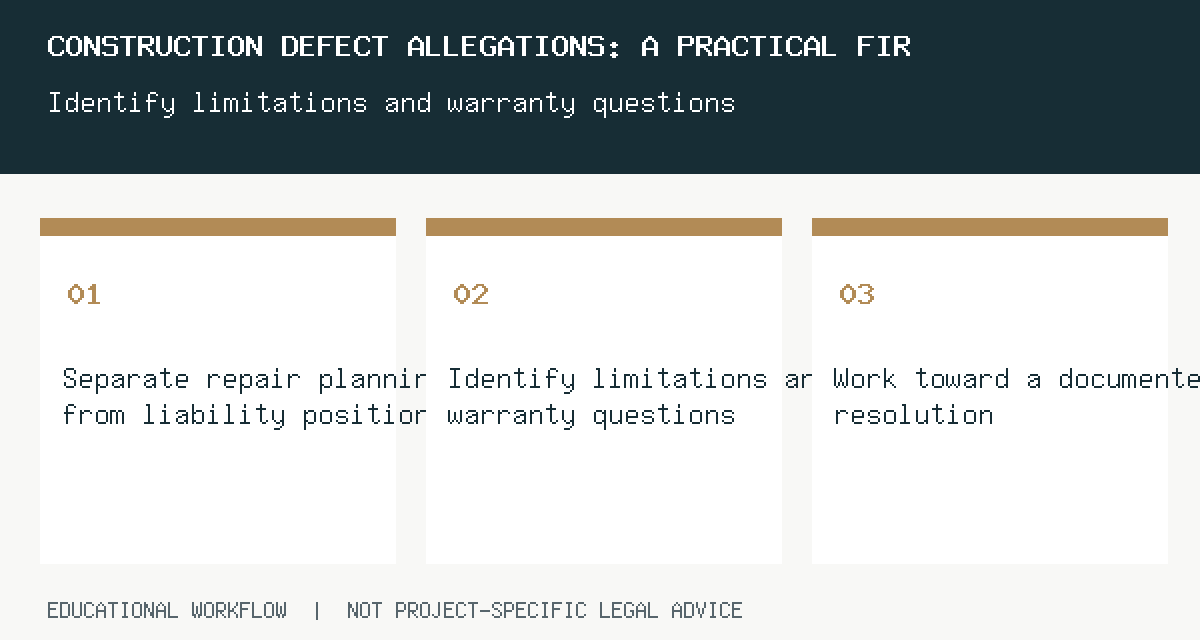
Project record checklist
- Address immediate safety and damage: Prioritize personal safety and reasonable mitigation; record what was done, by whom, when and why.
- Describe the observed condition neutrally: Write what was observed, where, when, weather conditions, affected materials and whether the condition recurs.
- Preserve original photographs and physical evidence: Take wide-angle and detail photographs, retain timestamps and keep removed material labeled when safe and appropriate.
- Collect the design and construction record: Gather contracts, plans, specifications, submittals, RFIs, change orders, inspections, warranties and relevant maintenance records.
- Map notice and insurance obligations: Identify relevant parties, notice recipients, policy information, discovery dates and communications already sent.
- Plan a focused technical inspection: Set a scope, invite appropriate participants when advised, record conditions and identify where testing may disturb materials.
- Separate repair planning from liability positions: Document temporary work, obtain reasoned repair options, preserve estimates and identify work that may affect evidence.
- Identify limitations and warranty questions: Prepare dates for completion, discovery, prior complaints, previous repairs and relevant contractual promises for legal review.
- Work toward a documented resolution: Use a deficiency log, inspection findings, repair scope, schedule, access plan and reservation of unresolved questions.
Questions people often ask
Should an owner repair suspected defects immediately?
Safety and preventing further damage matter. Document conditions and obtain appropriate professional advice before invasive work when feasible. The applicable agreement, contemporaneous records and particular project facts should be reviewed before making an irreversible decision.
Does a failed inspection establish negligence?
Not by itself. The significance of an inspection result depends on the standard, conditions and additional evidence.
Should contractors notify their insurers?
They should review applicable policies and reporting requirements promptly with appropriate advisors.
Can the parties investigate without filing suit?
Often they can discuss investigation and repair, although contracts, deadlines and evidence preservation still require attention.
Related construction law guidance
- Mechanics liens and payment rights
- Construction contracts and disputes
- Project claims and resolution
- Discuss the issue with construction counsel
For an independent reference, review California Courts limitations overview.
Legal information only, not legal advice. Requirements, defenses, and deadlines depend on the contract, project, jurisdiction and facts. Viewing this page does not create an attorney-client relationship. Consult qualified counsel about your circumstances.
Discuss your construction law matter
Construction disputes are fact-specific. Share the project background and learn how a focused legal review can help clarify your next decision.